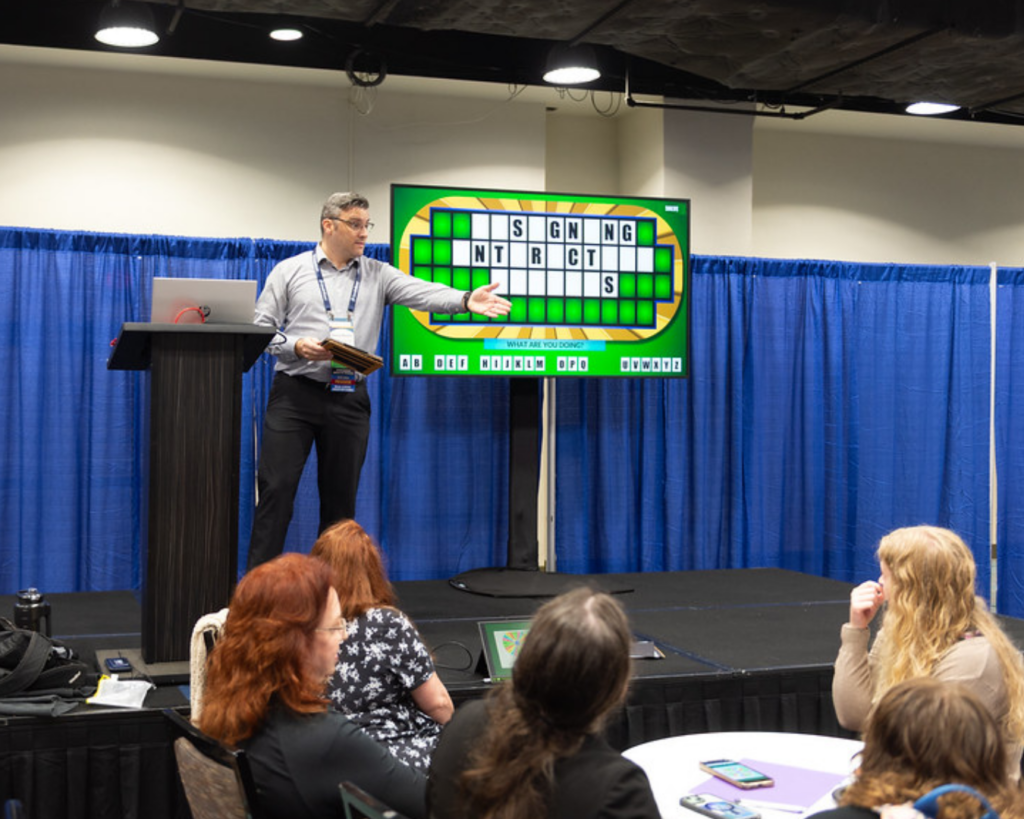
At OLC Innovate this past March, Dr. Tricia Bertram Gallant raised a provocative idea: fully asynchronous courses need synchronous opportunities to truly support student success.
I’ll be honest—that landed hard.
As someone who has spent years designing and teaching in asynchronous graduate programs, it felt like a bit of a dismissal of what intentional asynchronous design can actually do. Not because synchronous learning is inherently problematic, but because the implication seemed to be that something is missing without it—that connection, engagement, or quality somehow requires real-time interaction.
That has not been my experience.
Even though we are separated by time and space, I feel like I am with my students every day. I know their passion for the field and where they want to go. I know how they carve out time for coursework while caregiving for children, aging parents, and partners; managing full-time jobs; navigating difficult personal and professional responsibilities; and showing up for their families and communities. Then, when their days finally settle, they log into our course and do thoughtful, meaningful, high-quality work.
Asynchronous online programs often promise the flexibility that makes continuing education possible for adult learners. So, when we suggest that synchronous components are necessary for success, we need to ask ourselves a key question: What does it mean to design asynchronous learning intentionally, and how do we decide whether synchronous activities actually serve the learners these programs are built for?
This question matters because synchronous activities can add value. Live sessions, real-time conversations, orientations, guest speakers, and collaborative meetings can support connection, clarification, and engagement. But in fully asynchronous online programs, they can also create tension when they are added without a clear purpose or without paying attention to the realities of the learners these programs are designed to serve.
With that, I keep returning to something that has guided me throughout my career: learning experiences should be designed with one priority in mind—learners.
What Our Study Helped Us See
After hearing that keynote, I kept returning to the same learner-centered question that now frames this piece: how do we make intentional decisions about whether synchronous activities actually serve the learners these programs are built for?
That question connected directly to a practice-based institutional study I conducted with my colleague, Corey Davis, about synchronous activities in fully asynchronous graduate programs. We wanted to understand how the people closest to these programs (i.e., students, instructors, and program coordinators) perceived the role of synchronous activities, and the findings discussed here were presented at OLC Accelerate 2025.
The study took place at a regional public university in the Midwest and included closed- and open-ended survey responses from three groups connected to fully asynchronous graduate programs: graduate students (n=50, 5% response rate), online instructors (n=11, 26% response rate), and graduate program or certificate coordinators (n=5, 22% response rate). While the findings should be understood as practice-based insights rather than generalizable conclusions, they are useful in this moment because they mirror questions many online programs are currently facing and elevate student, instructor, and program leader perspectives in that conversation.
The narrative responses in our study were especially insightful, particularly where participants described when synchronous activities felt valuable, when they felt burdensome, and what made the difference. Across stakeholder groups, synchronous activities were not rejected outright. Students, instructors, and program coordinators identified moments when real-time interaction might be useful. Synchronous elements can have a place, particularly when they support real-time clarification and feedback, connection and engagement, or targeted high-value learning moments such as guest speakers, orientation, complex projects, or collaborative work.
But participants were equally clear that these benefits are conditional.
When synchronous activities are designed without centering learner realities, they can quickly become something else entirely.
Not a support.
A barrier.
One program coordinator described the issue as a matter of “truth in advertising,” explaining that if a course or program is described as asynchronous, then students should not be surprised by required synchronous activities later. Students may appreciate optional opportunities, but required live meetings can feel misaligned with the flexibility they were promised.
That distinction matters.
In asynchronous programs, flexibility is not a secondary feature. It is often central to access.
Where Synchronous Activities Break Down
The tension is not really about synchronous versus asynchronous learning. It is about alignment and intentional design around course and programmatic outcomes.
When synchronous activities are added because they feel more engaging, more personal, or more like “real teaching,” we risk designing from our own assumptions rather than from students’ lived realities. A live session may make sense to an instructor, but if it requires students to rearrange work and caregiving schedules or navigate time zone differences and unreliable technology challenges, the activity needs to offer value that justifies that disruption.
Participants in our study pointed to several recurring breakdowns.
First, synchronous activities can be misaligned with learner realities. Many students in fully asynchronous graduate programs are balancing full-time work, caregiving, and other responsibilities. One student in our study explained, “I chose to complete my education at my time. I do not mind optional events, but mandatory synchronous activities may not be easy for me to attend due to work and family obligations.”
That comment captures a larger issue. If students chose an asynchronous program because they needed flexibility, then required synchronous meetings can create additional stress instead of supporting learning.
Second, synchronous activities can introduce access and equity challenges. Even when sessions are labeled optional, they are not always equally accessible. Time zone differences, work schedules, family obligations, technology access, and internet reliability can all shape who is able to participate. One online instructor in our study noted that adding synchronous elements can create barriers for students with time constraints or in different time zones, ultimately diminishing the accessibility and inclusivity that asynchronous learning aims to offer.
In other words, “optional” does not always mean equitable.
Third, synchronous activities are sometimes overused or designed with questionable value. Several participants noted that many live meetings could have been an email, announcement, recording, or discussion post. One student in our study put it plainly: “Something that can be shared in an email, announcement, or on Canvas does not need to be discussed synchronously.”
That does not mean live interaction is never worthwhile. It means synchronous time needs to earn its place with purpose and intention.
If a synchronous activity is not clearly aligned with a learning outcome, it becomes difficult for students and instructors to justify the cost of attendance. In fully asynchronous programs, asking students to show up at the same time should be a meaningful design decision, not a default.
Practical Principles for Better Design
For educators, instructional designers, and program leaders, the takeaway is not to remove all synchronous opportunities from asynchronous programs. The takeaway is to use them with care. Across our study, five practical principles emerged:
1: Start with learner realities.
Design decisions should be grounded in the lived experiences of learners. Synchronous activities should not be added based on instructor or designer preference, habit, or assumptions about what good teaching should look like.
Before adding a live session, ask: Who are our learners? What are they balancing? What did this program promise them? What might this requirement make harder for them?
In practice, this might mean surveying students before scheduling any live component and using what you learn to decide whether the session should be offered live, asynchronously, or not at all.
2: Use synchronous time only when it adds irreplaceable value.
Synchronous time should be reserved for moments that cannot be done as effectively asynchronously. Real-time clarification, dialogue, mentoring, complex collaboration, or high-touch interaction may justify synchronous engagement.
But if a learning outcome can be achieved through an asynchronous option, that option should be seriously considered.
A helpful design question is: What can happen in this live moment that could not happen as well through a recording, announcement, discussion, collaborative document, feedback video, or other asynchronous strategy?
In practice, this might mean reserving synchronous sessions for project milestones that genuinely benefit from real-time dialogue, such as team planning, critique, or problem-solving that happens more efficiently or more deeply together at the same time.
3: Protect flexibility through optionality.
In fully asynchronous programs, synchronous activities should remain optional whenever possible. Students should not be penalized, explicitly or implicitly, for being unable to attend a live session.
If attendance is optional, the alternative should not be a lesser version of the learning experience. Recordings, asynchronous participation options, alternative reflection prompts, or equivalent pathways can help ensure students still have access to the learning opportunity.
In practice, this might mean offering an optional live Q&A, then providing a captioned recording and an asynchronous reflection or question-submission alternative.
4: Design for access, not just availability.
Even when a synchronous activity is optional, it still needs to be designed for access. Instructors and program leaders should consider when sessions are offered, who can realistically attend, and what barriers may shape participation.
Access also means thinking beyond the event itself. Will the recording be captioned? Can students ask questions asynchronously before or after? Is there a way for students who could not attend to still contribute? Are time zones considered? Is participation dependent on stable internet, private space, or technology that students may not have?
In practice, this might mean inviting questions before the session, captioning the recording afterward, and keeping a shared document open so students can contribute before, during, or after the live event.
5: Be transparent about modality.
If a program is advertised as asynchronous, expectations around any live components should be explicit, consistent, and aligned with that promise. Students should know before enrolling whether synchronous activities are required, optional, occasional, or embedded in particular courses.
This is not just a communication issue. It is a trust issue.
When students choose an asynchronous program, they are often making that decision based on the realities of their lives. Transparency helps them make informed choices and helps programs maintain integrity between what they promise and what they require.
In practice, this might mean including a clear modality statement on the program’s website and orientation experiences that explain whether live sessions are required, optional, recorded, or replaceable through asynchronous participation.
The Real Question
The keynote was not wrong to push on engagement and connection. Those things matter deeply.
But we need to be careful about how we get there.
Connection does not come from requiring people to show up at the same time. It comes from designing in ways that respect who learners are, what they are balancing, and how they are able to participate.
Synchronous activities are not inherently at odds with asynchronous learning. When thoughtfully designed, they can enhance connection, provide timely clarification, and create meaningful moments of interaction. But when they are overused or misaligned, they can undermine flexibility, access, and trust.
This is why the conversation is not only about modality. It’s about whether our design choices honor the realities that bring students to asynchronous learning in the first place.
That does not mean we should avoid synchronous opportunities altogether. It means we should treat them as intentional design choices rather than assumed markers of quality.
So maybe the better question is not: Do asynchronous courses need synchronous sessions to succeed?
Maybe the better question is: When does synchronous time add value that is worth the cost to learners?
If we can answer that question clearly, synchronous opportunities can strengthen learning. If we cannot, then we need to ask why we are adding them at all.
Note: Here is the presentation citation for the 2025 OLC Accelerate presentation:
Weber, N., Davis, C., & Vick, M. (2025, November). Synchronicity in an asynchronous world: What students, instructors, and administrators really think. Online Learning Consortium’s Accelerate Conference. Orlando, FL.