
Student success requires assistance, resources, and a holistic viewpoint from a variety of higher education professionals both inside and outside of the classroom. Taking an intentional approach to offering online classes that include meaningful engagement promotes student success, persistence, progression, and retention. Focusing on the design and delivery of the first few weeks of a class to ensure a user-friendly and engaged environment will set up students to be successful. Consider the W Curve Concept. The common usage of the W Curve Concept offers stages a newly admitted learner will go through, but I propose that it can also help guide the impression students have each time they access an online course for the first time especially when unfamiliar actions are required in a course, with unknown technology or if online courses are designed differently.
“The W Curve is a predictable pattern of stages which occurs when a person experiences culture shock. This is based upon research done with students studying abroad. Zeller and Mosier (1993) found that the W curve could also be applied to first-year college students and the phases they go through in adapting to a new culture. It is normal to have the ups and downs of the W curve and knowing about this may help make the transition easier. At the first signs of culture shock, some firstyear students may think this means they have made a mistake about going to college or that they have chosen the wrong school. If they see that this is just part of a journey that everyone goes through, they may be better able to take it all in stride (The College of New Jersey, 2015).”
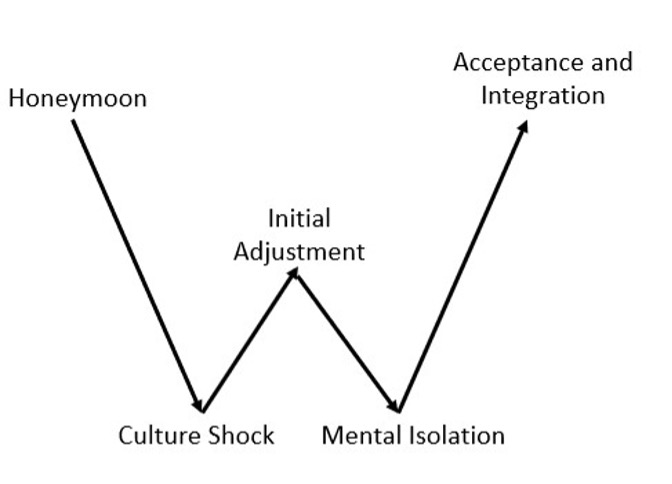
Image Description: A graphic representation of the W Curve Concept depicting a simple arrow following the shape of the letter “W.” From left to right, the high starting point of the “W” is labeled “Honeymoon.” The arrow travels down to the first lowest valley, labeled “Culture Shock.” The arrow travels upward to about half the height of the letterform, and this short peak is labeled “Initial Adjustment.” The arrow then travels down, again, into another low valley labeled “Mental Isolation.” The arrow’s journey ends as it travels upward, reaching the end of the letterform at full-height and towards the final label “Acceptance and Integration.”
The W Curve’s five phases have been shown to help students who are beginning their journey in higher education or those who are returning after a gap period. Consider using the concept of the W Curve when students begin an online course for the first time. Courses are designed differently with a variety of expectations, objectives, technology usage, and without familiarity with all areas included from one course to another. Each course may have components of a new culture. This could cause culture shock if there is not an intentional design to identify the unfamiliar areas of a course right from the beginning. The concept of the W Curve can be used to help students move through the phases quickly, especially to overcome culture shock or mental isolation when beginning a new course. Creating a course environment that moves into the acceptance and integration phase within the first week or two will contribute to an understanding of course expectations throughout the semester and will take into consideration how students are feeling thus reducing barriers.
The Honeymoon Phase
At first, students are excited, curious, and motivated to begin a new course. The possibilities of learning new course concepts, reviewing course materials, meeting and learning with new peers, and the opportunity to be mentored by an instructor create motivation and excitement. The Honeymoon Phase starts students off on a high emotional level. Consider the first impression students get when logging into an online course when it opens. Encouraging engagement and contributing to the engagement as an instructor will provide students with a sense of belonging in the classroom. Without the intentional assessment of recognizing barriers and challenges right from the beginning, students will experience a feeling of being overwhelmed with a high likelihood of deciding to drop the course. Opportunities for meaningful engagement will limit or completely remove the second phase of the W-Curve which is culture shock. What happens in the honeymoon phase can contribute to a higher likelihood of a learner’s continuing motivation.
Culture Shock
After the initial experience of the look and feel in a course culture shock can set in! Online classes have different objectives based on course content and on the necessity of learning different technologies and techniques. After the first time a student accesses a course, and as they begin to learn their expectations, ask yourself a few questions. What would make it the most user friendly? What does meaningful engagement look like related to specific course design and content? What are the barriers, such as a new technology or if there are criteria on what is allowed to be used such as artificial intelligence? What is unique about the course that would shock a student?
One recommendation is to include areas in the course where students can ask questions and get almost real-time answers. This will help them to either get out of this phase more quickly or skip it completely. An example I would like to share is the need for a not widely used technology in a statistics course that students are required to take at Penn State. The week for introducing this technology has been shown to be a challenging week for students. And those students who do not have extra time to stop and learn this technology tend to either drop the course or it starts to negatively impact the student’s grade because the unknown and new technology has become a barrier to success.
A second recommendation is similar but offered right at the beginning of the class. Instructors can offer a synchronous meeting within the first few days of the course and record it with an introduction of what to expect throughout the course. For example, complete a review of the different components of the course, and if applicable, demonstrate the new technology required to be used. While some students may not be able to attend, they can view the video at a later time. Pairing the meeting and video with a discussion board for peer-to-peer and instructor-to-peer discussions will enhance the ability to overcome a sense of being overwhelmed.
Initial Adjustment
Understanding expectations and starting to normalize the unknown areas of an online course creates an environment for students to become successful. Turning in the first assignment, connecting with peers through introductions and discussion boards, and having a sense of accomplishment with early tasks will move students into the Adjustment Phase. Routines will develop and students will gain confidence in their academic ability within the course. Meaningful engagement, both inside and outside of the classroom, contributes to their overall confidence in successfully meeting their educational goals.
It is incredibly important to stay engaged with students during this phase. Creating meaningful engagement opportunities between peers, and between students and instructors, encourages the next phase, Mental Isolation to be minimized or provides opportunity for it to be skipped completely. However, without engagement opportunities, it is likely that Mental Isolation happens without an awareness from instructors. The risk is that students will drop the course and you may never understand why it happens so early in the course.
Mental Isolation
As mentioned, one of the risks of the Mental Isolation phase is that students will drop the course without an awareness of why. Other risks in this stage are academic success may decrease, students will become overwhelmed, or they may go ‘missing’ with many uncompleted assignments. Students who feel siloed have an easier time dissociating themselves to the course. As we are aware, it is much easier to drop an online course with the one consequence of having a tuition bill compared to dropping residential courses and being responsible for more than tuition such as food, housing, or activity fees.
Awareness of a student in this phase is more difficult in the online classroom depending on required assignments, engagement opportunities and deadlines. Requiring weekly assignments and activities, such as discussion board posts, provides accountability and gives early indicators that students are not engaged. Creating an engaging and meaningful environment reduces the risk of mental isolation.
Acceptance and Integration
Once students feel connected and experience early accomplishments, they have a more “realistic and balanced perspective” within their courses (Bishop, 2023). They have now moved into the last phase and one that contributes to an increase in retention and progression.
The Acceptance and Integration Phase can occur early in the course by identifying and reducing barriers, including many engagement opportunities, and offering an ‘open door’ policy of connecting with others. Intentionally designing assignments that provide learning opportunities in areas that are new helps to either skip or decrease the time in other phases. Meaningful engagement early and often is key.
Summary
The W Curve offers a unique way of assessing online courses to ensure there are multiple opportunities for meaningful engagement. I have mentioned meaningful engagement throughout each phase of this article. Engagement promotes student retention and persistence within courses. Key components offered in this article predict a student’s user experience and how to intentionally address the barriers felt. Encouraging engagement early in the course helps students to either quickly move through, or skip, the phases of culture shock and mental isolation where students feel overwhelmed and siloed. The result is a sense of acceptance and integration.
Resources
Bishop, R. (2023). The w-curve model: Understanding a new college student’s experience. Mayo Clinic Health System. Speaking of Health. https://www.mayoclinichealthsystem.org/hometown-health/speaking-ofhealth/the-w-curve-theory
The College of New Jersey. (2015). The w-curve and the first year of college. Parent & Family Programs. chromeextension://efaidnbmnnnibpcajpcglclefindmkaj/https://parents.tcnj.edu/wpcontent/uploads/sites/14/2015/10/w-curve-article.pdf
Zeller, W. J., and Mosier, R. (1993). Culture shock and the first-year experience. Journal of College and University Student Housing 23(2).
Dr. Dawn Coder is the Acting Associate Vice Provost for Online Education, Student Engagement director of the World Campus Chaiken Center for Student Success at The Pennsylvania State University, World Campus. She has over nineteen years’ experience in the field of higher education and online learning in both public and private institutions, and twenty-four years’ experience in a leadership role. Her passions are creating positive work cultures through her founding philosophy of Mutual Goodwill and supporting initiatives that encourage student success in higher education.