In March’s Snap Survey, we asked two simple questions:
Who is the unsung hero of online learning at your institution?
What is the most underappreciated “treasure” supporting teaching and learning?
The responses were modest (n=23), but the signal was remarkably clear.
The Unsung Hero: The Quiet Architect
The top unsung hero for our participants was “The Quiet Architects,” otherwise known as instructional designers, often recognized not for visibility, but for impact. They are the ones building the invisible structures that make online learning possible: supporting faculty, aligning objectives, shaping experiences, anticipating friction points, and quietly ensuring that everything works. Their work is rarely the headline but without it, the system falters.
This metaphor of the “architect” is more than poetic; it reflects how the role has evolved. Instructional designers operate at the intersection of pedagogy, technology, and organizational context, translating theory into practice and shaping the conditions for meaningful learning. In other words, instructional designers are not just supporting online learning; they are actively engineering the environments in which it succeeds.
Research has long emphasized that effective online learning environments do not emerge organically; they are intentionally designed. Frameworks such as TPACK highlight the integration of content, pedagogy, and technology, while the Community of Inquiry model underscores the importance of cognitive, social, and teaching presence in shaping learner experience (Mishra & Koehler, 2006; Garrison, Anderson, & Archer, 2000). Instructional designers are often the ones quietly orchestrating these elements behind the scenes (Bennett & Albrecht, 2022).
One respondent added The Path Steward (Technologists tending the journey as much as the destination—clearing obstacles, nurturing growth, translating complexity, and illuminating the way so others can move forward with confidence). For many institutions, these roles are not separate. Instructional designers/technologists often serve as both architects and stewards, designing systems while also guiding faculty and learners through them. Both equally valuable and yet much of this work remains invisible.
If Instructional Designers Had a Character Sheet…
If we were to translate this role into something more visible, something that captures the full range of what instructional designers actually do, it might look less like a job description and more like a character sheet. This complexity is difficult to capture in traditional role descriptions. Instead, it resembles a layered, adaptive practice: one that blends expertise, strategy, and creativity.
Not a single competency, but a constellation of attributes (Nworie, 2022):
- High pedagogical knowledge, grounded in learning science
- Deep creativity, enabling engaging and meaningful experiences
- Strong technical fluency across platforms, tools, and modalities
- Extensive relational and facilitation skills, working across faculty, staff, and leadership
Alongside a toolkit that blends structure and strategy:
- Translating disciplinary expertise into student-centered design
- Aligning assessments with learning outcomes
- Applying accessibility and inclusive design principles
- Anticipating learner challenges and reducing cognitive load (Mayer, 2009)
To make that “invisible” work more visible, we imagined the instructional designer as a mythical character from a role-playing game: a Quiet Architect with a full set of skills, spells, and quests. If you were playing as this character, what special skills, spells, or abilities would be on your character sheet?
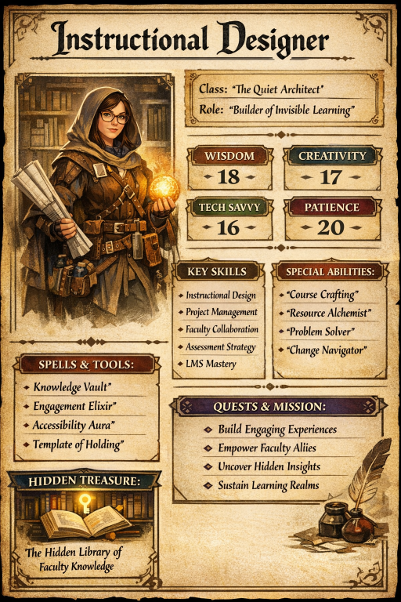
Image description: An AI-generated, stylized character sheet imagining an Instructional Designer as a character in a fantasy tabletop role-playing game. A depiction of the character is illustrated as a young woman cloaked in a heavy hood, adorned with various tools and holding a large scroll in one hand, and a glowing orb in the other. Their character class is “The Quiet Architect” and their role is “Builder of Invisible Learning.” Their starting values in wisdom, creativity, tech savvy, and patience are very high. The rest of their skills are outlined across the categories “Key Skills,” “Special Abilities,” “Spells and Tools,” and “Quests and Mission.”
The Hidden Treasure: The Library We Already Have
Respondents were equally divided about the hidden treasures on their campuses. The largest percentage of participants consider the most underappreciated resources to be The Secret Workshop (Instructional design capacity & development spaces) and The Unpolished Gem (Untapped partnerships or programs). These two are followed by The Sturdy Gate (Reliable infrastructure & LMS stability); The Open Map (Student voice & feedback); and The Crystal Archive (Institutional data & analytics), all tied for second place. Across these responses, a pattern emerges: the most valuable institutional resources are often the least visible, distributed across people, spaces, and systems rather than centralized or formally recognized.
The prominence of The Secret Workshop as a hidden treasure aligns closely with our unsung hero results. Often, instructional designers and technologists are “hidden” away in Centers for Teaching and Learning and, through necessity, engage in a “come to us” model of professional development that often relies on “on-demand” requests for support. Limited resources, personnel, and budgets can restrict the availability of these professionals who are still seen as important and powerful resources for the campus community.
Several respondents pointed to something equally powerful as a hidden treasure: Faculty expertise and institutional knowledge—The Hidden Library.
This “library” isn’t a system or a tool. It’s the accumulated insight, experience, and disciplinary knowledge that already exists within institutions. Yet, like many valuable resources, it is often underutilized, unevenly shared, or disconnected from design processes.
This finding aligns with broader research on organizational knowledge and socio-technical systems, which emphasizes that institutional effectiveness depends not only on tools and technologies, but on how human expertise is surfaced, shared, and integrated into workflows (Rousseau & Stouten, 2025).
Together, these responses tell a compelling story: Online learning doesn’t just run on innovation. It runs on people and knowledge systems that are already in place, but not always fully seen. This result also aligns with the runner-up to the unsung hero selection, The Torchbearer, those faculty innovators who are experimenting and leading the way. Their expertise and lived experience position them not only as knowledge holders but as catalysts for innovation, bridging practice, experimentation, and institutional change.
If Faculty Had a Character Sheet…
If instructional designers are the Quiet Architects, then faculty are the Torchbearers, carrying disciplinary expertise forward while navigating constant change. Their “character sheet” might look different, but no less complex:
- Deep content mastery, grounded in
- Evolving pedagogical practice, shaped through experience and experimentation
- Growing digital fluency, adapting to new tools and modalities
- Strong adaptive capacity, responding to shifting student needs and expectations
Their abilities include:
- Translating expertise into meaningful learning experiences
- Experimenting with new approaches and technologies
- Interpreting and responding to student feedback
- Bridging tradition and innovation in real time
If instructional designers build the structures, faculty bring them to life.
A Pattern Across the Series
This month’s findings build on themes emerging across our recent Snap Surveys:
- February (“Monsters”) surfaced the challenges: confusion, complexity, and friction in the learning experience
- March (“Heroes”) highlighted the people holding those systems together: instructional designers
- March (“Treasures”) revealed the underused assets: faculty knowledge and institutional insight
Taken together, these responses point to an important tension: Institutions often look outward for solutions, while underestimating the capacity already within (Menon & Pfeffer, 2003; Sulistiawan, 2022). This pattern suggests that many of the field’s greatest challenges and opportunities are not external, but internal.
Why This Matters Now
At a time when generative AI and emerging technologies are reshaping higher education, there is a growing focus on disruption, innovation, and transformation.
But these results suggest a complementary truth:
- The infrastructure of good learning design already exists
- The expertise needed to adapt is already present
- And the people doing this work are already embedded in our institutions
The challenge is not only to innovate, but to recognize, connect, and invest in what we already have.
Recognizing the Invisible
Instructional designers don’t just build courses. They build the conditions for learning. They translate between pedagogy and technology. They support faculty while shaping student experience. They anticipate needs that others don’t yet see.
Recognizing instructional designers also requires recognizing the faculty expertise that complements and extends their work. Faculty serve as both knowledge stewards and innovation leaders, bringing disciplinary depth, experimentation, and lived teaching experience into the design process. It is at the intersection of these roles where design meets practice that the true capacity for transformation emerges.
In many ways, the Snap Survey captured this ecosystem well: Quiet Architects designing the structures, and Torchbearers advancing practice and innovation within them. Together, they shape the conditions that make meaningful learning possible. The question is no longer whether these roles matter, but whether institutions are ready to fully recognize, connect, and resource their collective impact. The future of online learning may depend less on what we build next and more on whether we choose to see what is already there.
About OLC Snap Surveys
OLC Snap Surveys provide quick insights into emerging trends, challenges, and perspectives in digital learning. Surveys are distributed to the OLC community and offer a rapid way to capture practitioner experiences across institutions.
OLC welcomes participation in future Snap Surveys to help inform ongoing conversations about the future of online and digital learning. Subscribe to OLC Today, our weekly newsletter, to get the latest Snap Survey delivered directly to your inbox.
References
Bennett, L., & Albrecht, A. (2022). Analyzing the instructional designer role: A new framework to improve efficacy and dynamic partnerships. Distance Learning, 18(4), 7-18. https://doi.org/10.1108/DL-04-2022-0002
Garrison, D. R., Anderson, T., & Archer, W. (2000). Critical inquiry in a text-based environment: Computer conferencing in higher education. The Internet and Higher Education, 2(2–3), 87–105.
Mayer, R. E. (2009). Multimedia learning (2nd ed.). Cambridge University Press.
Menon, T., & Pfeffer, J. (2003). Valuing internal vs. external knowledge: Explaining the preference for outsiders. Management Science, 49(4), 497-513. https://doi.org/10.1287/mnsc.49.4.497.14422
Mishra, P., & Koehler, M. J. (2006). Technological pedagogical content knowledge: A framework for teacher knowledge. Teachers College Record, 108(6), 1017–1054.
Nworie, J. (2022). The Increasing Quest for Instructional Designers and Technologists in Higher Education and Corporate Settings. Contemporary Educational Technology, 14(1). https://doi.org/10.30935/cedtech/11481
Rousseau, D. M., & Stouten, J. (2025). Experts and expertise in organizations: An integrative review on individual expertise. Annual Review of Organizational Psychology and Organizational Behavior, 12, 159-184. https://doi.org/10.1146/annurev-orgpsych-020323-012717
Sulistiawan, J., Moslehpour, M., Diana, F., & Lin, P. K. (2022). Why and When Do Employees Hide Their Knowledge?. Behavioral Sciences, 12(2), 56. https://doi.org/10.3390/bs12020056
As senior researcher at OLC, Carrie designs, conducts and manages the portfolio of research projects that align with the mission, vision, and goals of the Online Learning Consortium. She brings with her over 15 years of experience as an online educator and instructional designer with a passion for research. She has peer-reviewed publications covering a variety of topics such as open educational resources, online course best practices, and game-based learning. In addition to a strong background in higher education teaching and instructional design, Carrie brings with her extensive experience in customer service and small business management. She holds a PhD in Educational Technology from Arizona State University, an MS in French from Minnesota State University, and BA in French from Arizona State University.