Online and hybrid learning are now standard, not exceptions. However, many educators still feel unprepared, overwhelmed, or resistant when teaching online. They might have access to strong platforms and tools, but without proper guidance, those tools often go unused or are misapplied.
That’s where faculty development truly makes a difference. When institutions support their educators, they open up new opportunities for student engagement and success. The good news? It doesn’t always mean drastic changes. Often, the most effective improvements start small.
Here are five practical strategies that institutions can adopt right now to enhance online and hybrid learning through faculty development.
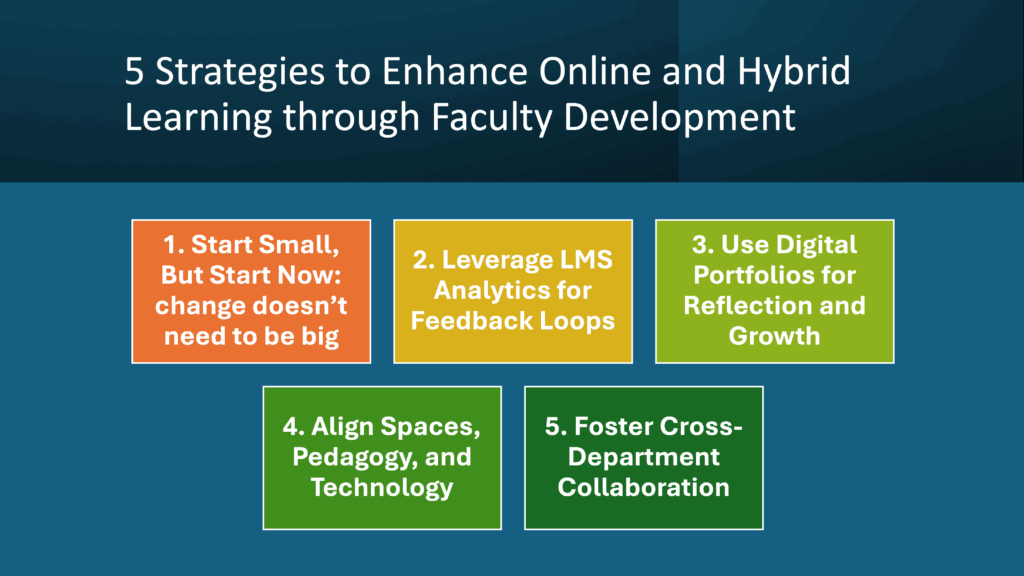
1. Start Small, But Start Now
One of the biggest hurdles for faculty is the fear of taking on too much at once. Redesigning an entire online course can feel like climbing a mountain with no clear summit. The solution? Start with a single step.
Encourage faculty to choose one course element and rethink it for online learning. Maybe it’s replacing a 30-minute lecture video with a five-minute mini-lecture plus an interactive poll, or swapping out a weekly discussion prompt for a collaborative brainstorming board.
When faculty begin with small, achievable experiments, they experience quick wins. Those early successes build confidence and create momentum for deeper redesigns over time.
Takeaway: Change doesn’t need to be massive to be meaningful. Start with one small innovation, then grow from there.
2. Leverage LMS Analytics for Feedback Loops
Most learning management systems (Canvas, Blackboard, Moodle, D2L, and others) already capture a wealth of data. The problem is that many faculty don’t know how to make sense of it. That’s a missed opportunity.
Faculty development workshops can show instructors how to use analytics as a feedback loop. For instance, if data shows a drop in student logins by week three, it may signal that learners feel disconnected. A quick intervention, such as a personalized check-in email or a short video message, can pull students back into the course.
Similarly, analytics around discussion board participation can highlight which prompts spark genuine engagement and which ones fall flat. By helping faculty interpret and act on these patterns, institutions empower them to create more responsive courses.
Takeaway: Data isn’t just numbers. It’s a story about student behavior, and faculty can use it to improve learning in real time.
3. Use Digital Portfolios for Reflection and Growth
Grades are one way to measure progress, but they don’t always capture the full story. Digital portfolios give students space to showcase their learning journey, not just their final products.
Faculty development programs can introduce instructors to portfolio tools and models. For example, in a writing course, students might collect drafts, peer feedback, and final essays to demonstrate growth over the semester. In professional programs like teacher education, portfolios can serve as evidence of skill development and reflection.
The benefits extend to faculty as well. Instructors can use portfolios to reflect on their own teaching practice, documenting what worked, what didn’t, and how they’ve adapted over time. Besides, some of the frameworks that assess your teaching require a substantial documentation of your reflections, so with the portfolio, it would be easier in this sense.
Takeaway: Portfolios encourage deeper learning and provide both students and faculty with a record of growth and achievement.
4. Align Spaces, Pedagogy, and Technology
When we talk about “spaces,” it’s easy to picture physical classrooms. But digital environments are also spaces that require thoughtful design. Too often, technology is layered on top of pedagogy as an afterthought. The real challenge is alignment.
Faculty developers can guide instructors to think about the relationship between space, pedagogy, and technology. For example:
- Instead of using breakout rooms just for discussion, treat them as collaborative labs where students co-create documents or presentations.
- Rather than recording long lectures, design short learning bursts paired with interactive activities in the LMS.
- When possible, connect online learning with physical spaces (e.g., encouraging students to share field photos, observations, or experiments).
When faculty understand how digital “space” shapes learning, they design with more intention and creativity.
Takeaway: Strong online courses emerge when pedagogy, space, and technology work in harmony.
5. Foster Cross-Department Collaboration
Effective online learning doesn’t happen in isolation. It requires collaboration between faculty, instructional designers, IT staff, librarians, and student support teams. Yet in many institutions, these groups remain siloed.
Faculty development programs can act as the bridge. Imagine hosting a design sprint where an instructor, a librarian, and a technologist tackle a course redesign challenge together. The librarian suggests curated resources, the technologist offers integration options, and the instructor brings pedagogical vision. The result? A course that is richer and more sustainable than any one person could have built alone.
Cross-department collaboration also ensures that faculty don’t feel they have to be experts in everything. They can rely on a support network while focusing on what they do best, which is teaching.
Takeaway: Breaking down silos leads to more innovative, resilient, and student-centered courses.
Conclusion
The landscape of digital learning is shifting rapidly, but one truth remains constant: faculty development is the engine that drives quality online and hybrid education.
By encouraging small steps, using data wisely, adopting digital portfolios, aligning pedagogy with technology, and fostering collaboration, institutions can equip their educators to thrive in any learning environment.
Change doesn’t have to wait for the next big initiative or budget cycle. Faculty can begin experimenting with these strategies right now, building confidence along the way. The result? Online learning experiences that are not only more effective but also more human.
Aiman Khamitova, Ed.D., is an Innovative learning officer at Nazarbayev University (Kazakhstan). She provides support to faculty around pedagogy in a tech-mediated environment through training events and individual consultations. She helps in designing online and blended courses, as well as provides consultancy on course facilitation.